
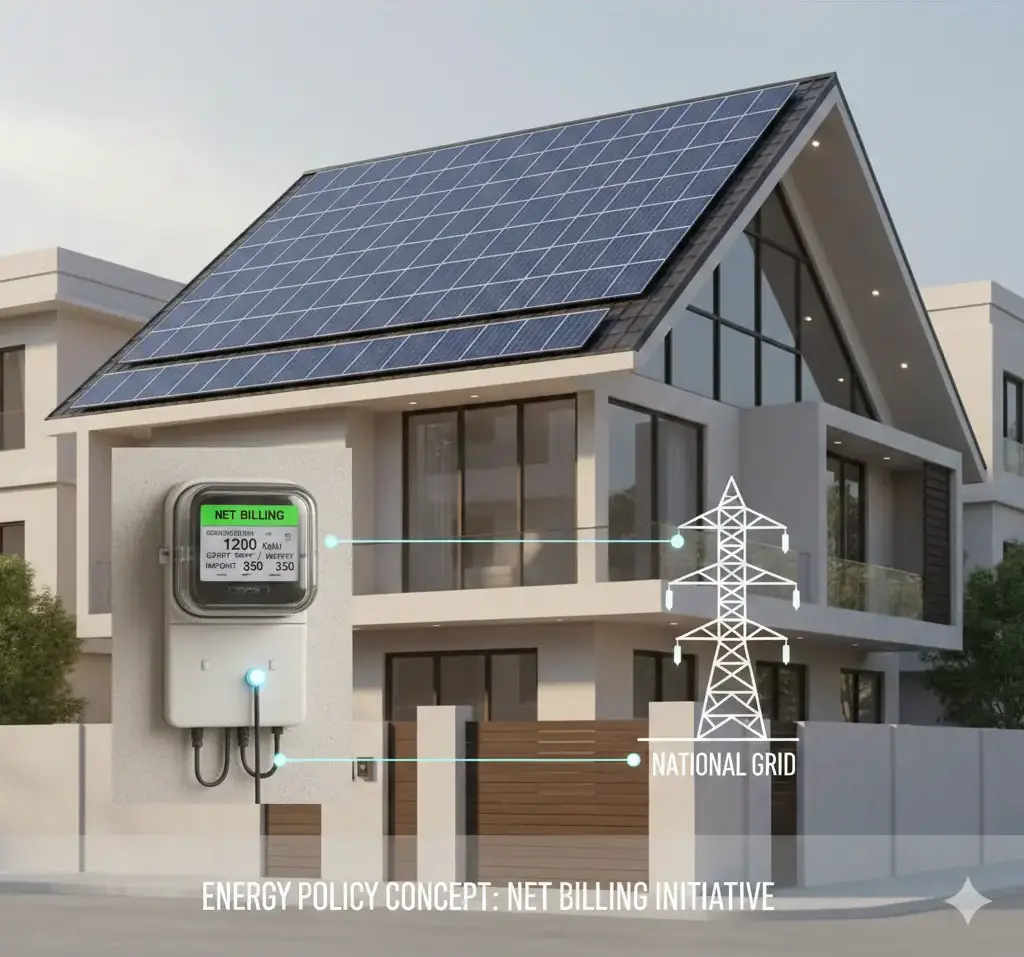
Pakistan’s rooftop solar sector has undergone a major policy shift as the National Electric Power Regulatory Authority (NEPRA) has formally abolished the exchange-based net metering system, replacing it with a net billing regime under the newly notified NEPRA (Prosumer) Regulations, 2026.
The move effectively ends the decade-old net metering framework introduced in 2015 and fundamentally changes how solar and other small power generators are compensated for electricity supplied to the grid.
Buyback Rate Likely to Fall to Rs11 Per Unit
Under the existing net metering system, solar consumers were receiving a buyback rate of approximately Rs25.9 per unit through one-to-one unit adjustment. Under the new net billing structure, surplus electricity exported to the grid will instead be purchased at the national average energy purchase price, which stakeholders say is likely to be around Rs11 per unit.
While the revised buyback rate has not yet been formally notified, the Rs11 figure was discussed during consultations between NEPRA, the Ministry of Energy, and other stakeholders.
At the same time, electricity drawn from the grid will be billed at the applicable consumer tariff, which in some cases may reach Rs50 per unit, significantly altering the cost-benefit equation for rooftop solar users.
Contract Period Reduced to Five Years
NEPRA has also reduced the standard contract duration for prosumers from seven years to five years, renewable by mutual consent. Existing solar consumers will continue under their current agreements until expiry; however, distribution companies (Discos) have been authorised to either terminate or migrate consumers to the new policy once contracts expire.
Shift of Capacity Payment Burden
Industry sources say the new policy effectively shifts part of the capacity payment burden of Independent Power Producers (IPPs) onto solar consumers. With the end of unit exchange, consumers will now be required to pay the net difference between electricity imported from and exported to the grid.
This change has sparked concern among renewable energy advocates, with critics warning of potential political backlash as net metering, once a key incentive for rooftop solar adoption, is now largely non-existent.
Scope and Applicability of New Regulations
The Prosumer Regulations, 2026 apply to solar, wind, and biogas systems with a maximum generation capacity of up to 1 megawatt (MW). System size is capped at the consumer’s sanctioned load, and no new connections will be allowed if distributed generation on a transformer exceeds 80% of its rated capacity.
Projects of 250 kW or above will be required to undergo a mandatory load flow study before approval.
Application Timelines and Compliance Requirements
NEPRA has introduced strict timelines for utilities:
- Application acknowledgement within 5 working days
- Technical evaluation within 15 working days
- Installation of interconnection facilities within 15 days after payment
Prosumers must also obtain formal concurrence from NEPRA, which the regulator says will be issued within 7 working days.
All interconnection costs, including meters and any required grid upgrades, will be borne by the prosumer. NEPRA has also introduced a non-refundable concurrence fee of Rs1,000 per kilowatt.
Metering, Disconnection, and Regulatory Powers
The regulations mandate two-way metering, either through a single bidirectional meter or dual meters. Utilities retain the authority to disconnect systems in cases of faults, non-compliance, or maintenance, with or without prior notice.
Prosumers are prohibited from selling electricity to third parties using the utility’s network.
NEPRA has also granted itself broad powers to revise purchase rates during the life of agreements, issue binding directions, request operational data, impose penalties, and relax or modify regulatory provisions when required.
A Major Policy Reversal
The transition from net metering to net billing marks one of the most significant reversals in Pakistan’s renewable energy policy. While the regulator argues the new framework will improve grid stability and financial sustainability, it also redefines the economics of rooftop solar at a time when distributed generation is rapidly expanding across the country.
Energy experts say the focus for future solar users is likely to shift toward maximising self-consumption rather than exporting surplus electricity to the grid.